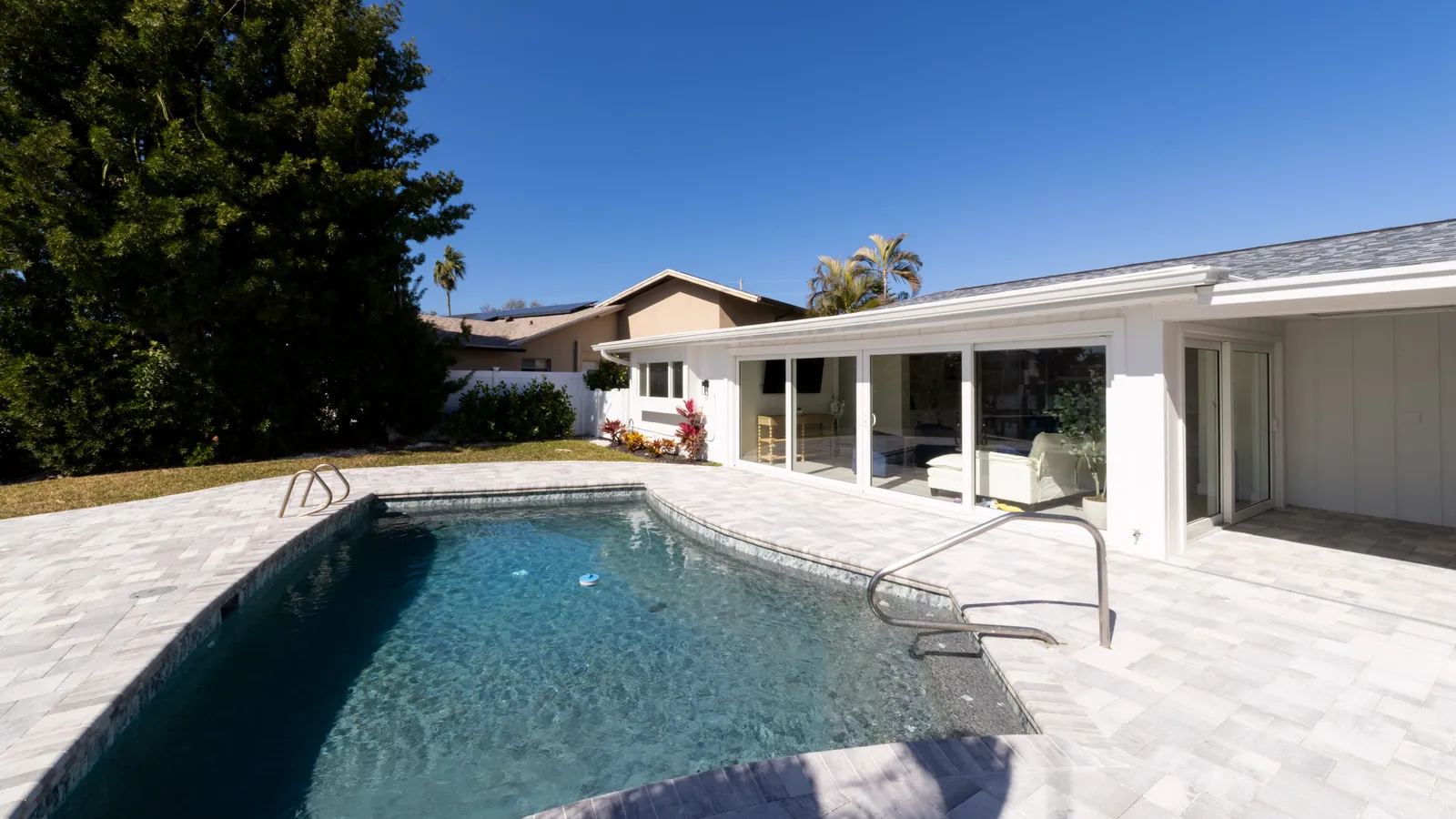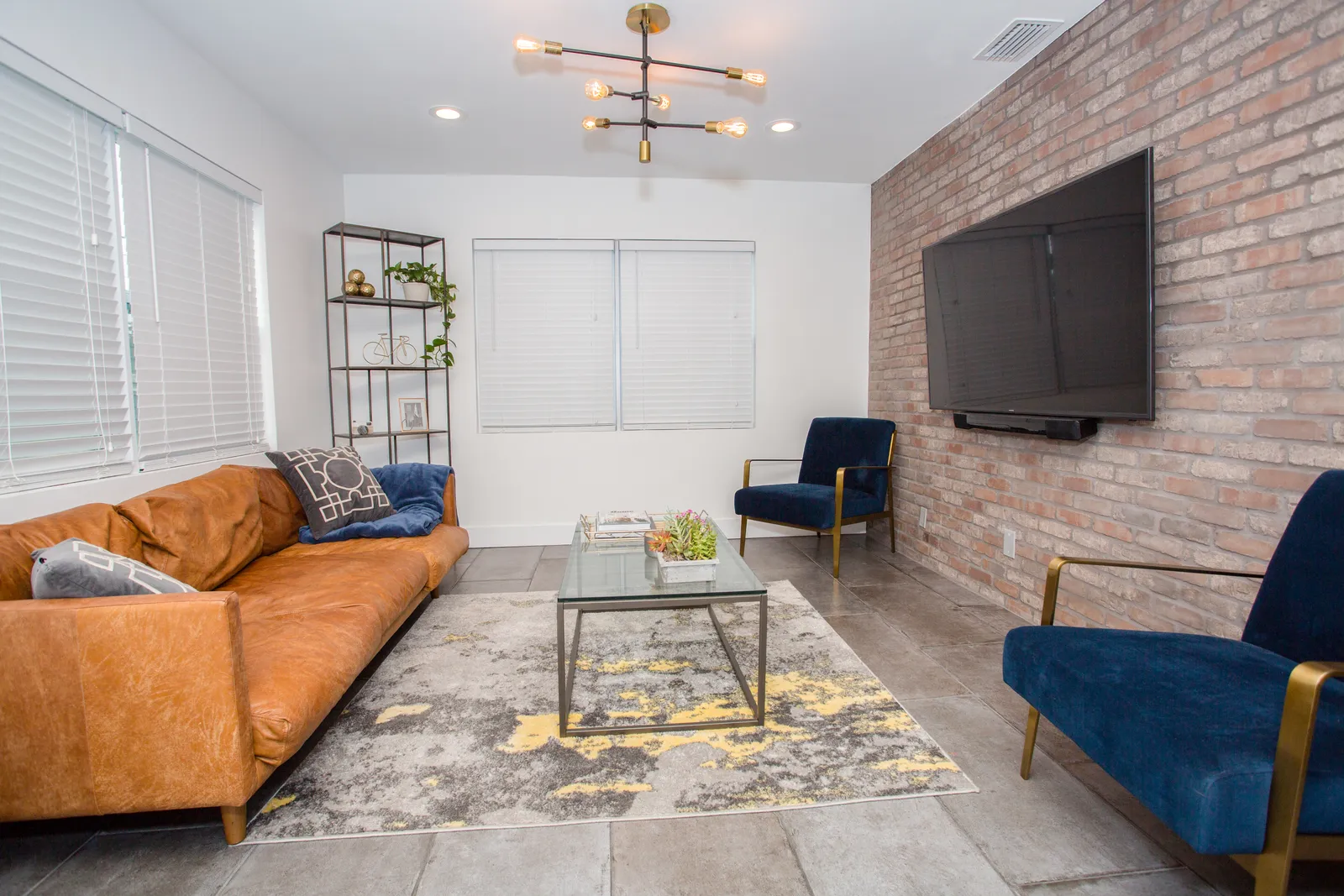

The rules come from the Florida Building Code, which applies statewide. The permit comes from one local office: usually the city if your home is inside city limits (a few small cities have the county permit for them), and the county if it is not.
This guide covers bathrooms first, then kitchens, additions and single-trade jobs, who issues permits in Hillsborough, Pinellas, Manatee and Sarasota counties, and how the process runs. We pull the permits on every project we build as a licensed general contractor. Your building department still has the final word for your address.
Which bathroom work needs a permit
Most of a real remodel is permit work. The line falls between finishing surfaces and changing the systems behind them.
| Work | Permit? | Notes |
|---|---|---|
| Paint, wallpaper, floor tile, vinyl, cabinets, vanity top | Generally no | Finish work. Hillsborough County lists it as exempt regardless of cost, as long as no structure is altered. |
| Fix a leak or clear a clog | No | Repairs are exempt in Hillsborough County. Replacing concealed defective pipe is not. |
| Replace a toilet, sink or faucet in the same spot | Depends on the office | The City of Tampa issues a plumbing trade permit, without plans, for like-for-like fixture replacement. |
| Move a toilet, sink, tub or shower | Yes | Plumbing work, filed with plans as part of the remodel. |
| Add a circuit, outlet, light, heated floor or exhaust fan | Yes | Altering the electrical system needs a permit in Hillsborough County. Electrical work never qualifies for the $7,500 exemption. |
| Replace a bathroom window | Yes | A building trade permit in the City of Tampa. A different size opening needs plans. |
| Remove or move a wall, or change a doorway | Yes | Building permit with plans. |
In the City of Tampa the remodel as a whole is filed as one building alteration permit, with plans.
The $7,500 exemption
Since July 1, 2026, state law requires cities and counties to exempt owners of single-family homes, and their contractors, from a building permit for work valued under $7,500.
The exemption has hard limits. It never covers electrical, plumbing, structural, mechanical or gas work, or any property partly or fully in a flood hazard area. You must send a written request with the contract or other proof of the work’s value. Splitting a project to get under the limit is not allowed.
So a cosmetic refresh may qualify, and a remodel that moves or replaces plumbing does not. Exempt work still has to meet the code, and your association’s rules still apply.
Kitchen remodel permits
Kitchens follow the same line. New cabinets and countertops in the same places are finish work. The permits come with what sits behind them.
- Moving the sink, or adding a dishwasher, an island sink or a pot filler: plumbing.
- A new circuit for a range, wall oven, microwave or island outlets: electrical.
- A gas line for a range or cooktop: gas.
- A range hood vented outdoors: new wiring and a new opening in the wall or roof.
- Opening the kitchen to the living room: a building permit with plans, with the beam sized for the load if the wall is load-bearing.
In the City of Tampa a kitchen remodel is filed as a building alteration with plans, like a bathroom. For what the work costs, see our kitchen remodel cost guide, and for how we run kitchens, our kitchen remodeling page.
Additions, conversions and outdoor rooms
Every addition needs a building permit with plans. It starts with zoning: how close you can build to the property lines, how much of the lot you can cover and how tall you can go.
The City of Tampa files these as additions too: converting an attached garage, a covered patio or deck, an attic or an attached carport into living space. Converting a detached garage is filed as an alteration.
In a flood zone, an addition counts toward the FEMA 50 percent rule, which can bring the whole building up to new-construction flood rules; see the FEMA 50 percent rule in Florida.
Decks, pergolas, screen rooms, sunrooms, pools and pool cages, generators and sheds each take their own permit in the City of Tampa. A residential shed of 150 square feet or less is exempt.
For budgets, see our room addition cost guide and our room additions page.
Roofs, windows, A/C and water heaters
These jobs involve one trade. They need a permit but usually no plan review. The City of Tampa lists them as trade permits:
- Window, exterior door and garage door replacement: building trade permit. A different size opening needs plans.
- A/C replacement and residential duct replacement: mechanical trade permit.
- A water heater in the same spot, with no change of fuel: plumbing trade permit.
- Panel replacement, a rewire, or new fixtures and devices: electrical trade permit.
- Re-roofing: roof trade permit. Areas of 500 square feet or less are exempt.
- Drywall, stucco or siding over 500 square feet: trade permit. Areas of 500 square feet or less are exempt.
Other offices draw these lines a little differently, so treat this list as an example, not the rule for your address.
Who issues permits in Hillsborough, Pinellas, Manatee and Sarasota
Your address decides the office, not your mailing city. A Tampa, Clearwater or Sarasota mailing address can sit outside city limits, in unincorporated county land. The county property appraiser’s record shows which jurisdiction a parcel is in.
| County | Outside city limits | Cities with their own building department |
|---|---|---|
| Hillsborough | Hillsborough County Development Services, through HillsGovHub. This covers places such as Brandon, Riverview, Lutz, Valrico and Town 'n' Country. | Tampa (Construction Services, through Accela), Temple Terrace and Plant City. |
| Pinellas | Pinellas County Building and Development Review Services. This covers places such as Palm Harbor, East Lake and Lealman, and the county also permits for Belleair Beach, Belleair Shore, Indian Rocks Beach, Oldsmar and Safety Harbor. | St. Petersburg, Clearwater, Largo, Seminole, Pinellas Park, Dunedin, Tarpon Springs, St. Pete Beach, Belleair, Gulfport and the beach towns not listed with the county. Belleair Bluffs uses a private provider. |
| Manatee | Manatee County's Building Division, through Accela. This covers places such as Parrish, Ellenton and the Manatee side of Lakewood Ranch. | Bradenton runs its own permitting. Longboat Key permits the whole town, across both counties. |
| Sarasota | Sarasota County Planning and Development Services, through Accela, with offices in Sarasota and Venice. This covers places such as Osprey, Nokomis and the Sarasota side of Lakewood Ranch. | Sarasota, Venice and North Port. Longboat Key permits the whole town. |
For questions before you apply, the City of Tampa’s Construction Services office answers at (813) 274-3100, option 1, and Hillsborough County Development Services at (813) 272-5600.
How a permit works, from application to final
1. Scope and plans
Your contractor writes the scope and, for an alteration, draws plans showing the layout, plumbing, electrical and any structural change.
2. Application and review
The permit holder applies online.
For a single-family home under 7,500 square feet, Florida gives the office 30 business days from a complete application to decide, when its own plans reviewer is used. Some smaller jobs on existing homes, valued under $15,000, get a 5-business-day clock. The fee drops 10 percent for each business day the office runs late.
3. Notice of Commencement
On a job over $2,500, Florida’s lien law requires the owner to record a Notice of Commencement with the county clerk. A copy must be posted at the site before the first inspection.
Without it, you can end up paying twice if a subcontractor or supplier goes unpaid. The notice lasts one year from recording unless it states otherwise.
4. Inspections
Inspectors check the rough plumbing, electrical and framing before the walls close, then the finished work.
Florida offices must accept inspection requests electronically, and the City of Tampa can inspect qualifying trade permits by video.
5. Final and closing
The permit closes when the final inspection passes. Ask for proof that it is closed.
A single-family permit expires one year after it is issued, or when the next edition of the code takes effect if that is later, unless the office extends it.
One timing note: Florida is moving from the 8th Edition to the 9th Edition (2026) of the Florida Building Code. If you apply around the changeover, ask which edition your plans will be reviewed under.
What a remodeling permit costs
Each office sets its own fee schedule, so there is no statewide price. Ask your contractor to show permit fees as their own line in the estimate.
Florida adds two surcharges to every local permit fee: 1 percent for the Florida Building Commission and 1.5 percent for the state’s building code board and Homeowners’ Construction Recovery Fund. Each has a $2 minimum.
Starting without a permit costs more: Temple Terrace’s fee schedule, for one, adds a stop-work fee. What the remodel itself costs is in our bathroom remodel cost guide.
Pulling the permit yourself
Florida lets you act as your own contractor on a one- or two-family home for your own use, under the owner-builder exemption. The conditions are strict.
- You must appear in person and sign the permit application.
- You must supervise the work directly, on site, and cannot hand that duty to anyone who is not licensed for the work.
- You cannot hire an unlicensed person to act as your contractor. Unlicensed workers you hire are your employees, with the tax withholding and workers’ compensation that comes with that.
- If you sell or lease the home within one year of finishing, the law presumes you built it for sale, which the exemption does not allow.
Watch for one trap. An unlicensed contractor asks the homeowner to pull an owner-builder permit, and the homeowner takes on the legal and financial risk, including injuries on the job. The Florida Department of Business and Professional Regulation warns against exactly this. Check any contractor’s license at MyFloridaLicense.com, and read how to choose a remodeling contractor.
The other route is to hire one of the remodelers who handle permits as part of the job. The licensed contractor applies as the contractor of record, books each inspection and sees the permit closed once the last one passes, which is how our permits and inspections service runs on our own projects.
What happens if you skip a permit
The building department can stop the job. The City of Tampa has a compliance team for work without a permit, and its inspectors issue stop-work orders.
Making the work legal afterward means a permit anyway, and the inspector may need walls or ceilings opened. Permit records are public, so missing permits can come up when you sell.
Remodeling permit questions
Do I need a permit to retile a shower?
Not to replace the tile itself, which is finish work. If the job replaces the shower pan, the valve or any piping, it becomes plumbing work. The City of Tampa permits that as a plumbing trade job, and the $7,500 exemption never covers plumbing.
Does a condo bathroom remodel need a permit?
Yes, on the same rules as a house, and usually your association’s written approval as well. The City of Tampa files condo unit permits on its commercial applications, and the $7,500 exemption applies only to single-family homes. Our condo remodeling page covers the association side.
Do repairs after a hurricane or a leak need a permit?
Usually, though offices can ease the rules after a declared disaster. The City of Tampa can then waive permits for limited work, such as drywall repair up to two feet above the floor. Hillsborough County lets emergency repairs be filed the next business day. In a flood zone, Tampa still requires a substantial improvement form even when no permit is needed.
Can a contractor start work before the permit is issued?
No. Florida law makes it unlawful to build, alter or repair without first getting the required permit. In the City of Tampa even partial or exploratory demolition is filed under the alteration permit, so tear-out waits too.
Sources
- 1.Florida Statutes (2026) s. 553.73 (opens in a new tab), checked
- 2.City of Tampa Construction Services, How to Select a Permit Application Type (rev. 11/20/2020) (opens in a new tab), checked
- 3.Hillsborough County, Work Exempt from Permits (opens in a new tab), checked
- 4.Florida Statutes (2026), s. 553.79 (opens in a new tab), checked
- 5.City of Tampa, Trade Permit (BTR) Guidelines, updated 11/14/2025 (opens in a new tab), checked
- 6.FEMA, Glossary: Substantial Improvement (44 CFR 59.1) (opens in a new tab), checked
- 7.Pinellas County, Building Departments in Pinellas County (opens in a new tab), checked
- 8.Hillsborough County, Development Services, Permits for Homeowners (last modified 10/12/2026) (opens in a new tab), checked
- 9.City of Tampa, Post-Hurricane Permitting Guide (April 2026) (opens in a new tab), checked
- 10.City of Temple Terrace, Building Division (opens in a new tab), checked
- 11.Manatee County, Building Division (opens in a new tab), checked
- 12.City of Sarasota, Building & Permitting (opens in a new tab), checked
- 13.Sarasota County, Planning and Development Services, Building (opens in a new tab), checked
- 14.Florida Statutes (2026) s. 553.792 (opens in a new tab), checked
- 15.Florida Statutes (2026), ss. 713.02(5) and 713.13 (opens in a new tab), checked
- 16.Florida Statutes (2026) s. 553.721 (opens in a new tab), checked
- 17.Florida Statutes (2026) s. 468.631 (opens in a new tab), checked
- 18.City of Temple Terrace, Building Permit Fees Schedule (opens in a new tab), checked
- 19.Florida Statutes (2026), s. 489.103(7) (opens in a new tab), checked
- 20.Florida Building Commission, Analysis of Changes for the 9th Edition (2026) FBC, Existing Building (opens in a new tab), checked