
Served from our Seminole office
Home remodeling in St. Pete Beach, FL
A larger St. Pete Beach remodel is planned against the 50 percent rule, Pass-a-Grille’s historic board and the coastal line. The city invites a review meeting before anyone applies.
St. Pete Beach in brief
City of St. Pete Beach Building Department
Filed online, through the iWorQ permitting system.
FEMA maps adopted August 24, 2021
New residential and commercial plans must comply with them.
Seminole office
9191 Park Blvd, about 9 miles north as the crow flies.
Hurricane Milton
October 9, 2024, NHC report (opens in a new tab)
Hurricane Helene
September 26, 2024, NHC report (opens in a new tab)
Hurricane Idalia
August 30, 2023, NHC report (opens in a new tab)

What to know in St. Pete Beach
Past fifty, and half in larger buildings
The 2020 to 2024 survey puts the city’s median construction date at 1971, so home remodeling in St. Pete Beach often meets a building past fifty. An estimated 48.0 percent of its housing units are in buildings with five or more units, and the rest are in smaller structures, single-family houses among them.
More on the houses
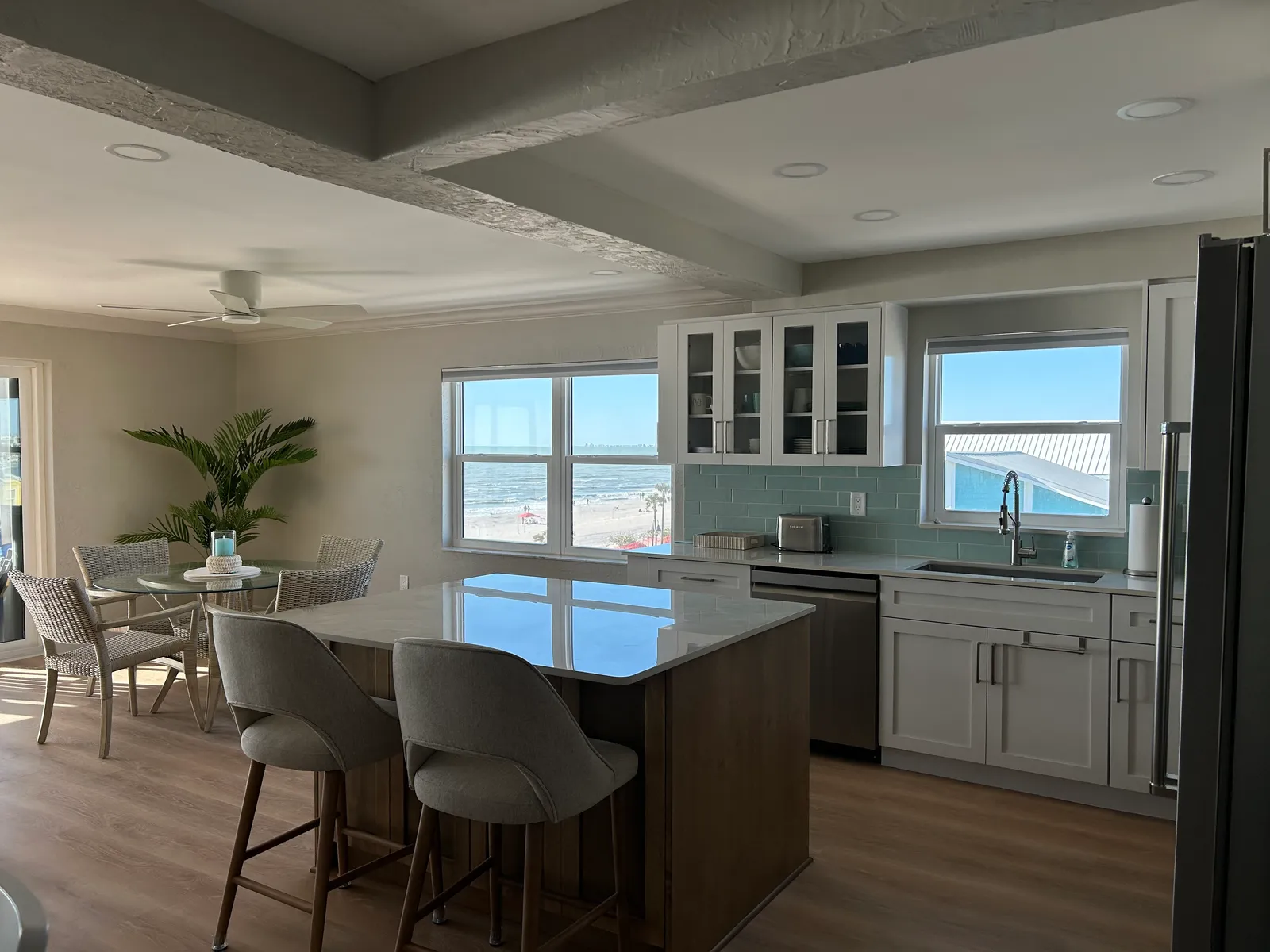
In the larger buildings, a kitchen or a St. Pete Beach bathroom is rebuilt inside a unit, under the building’s rules as well as the city’s. Florida law lets a local enforcement agency require a condominium’s milestone structural inspection at 25 years instead of 30 when local circumstances, such as nearness to salt water, call for it. For a unit owner, that inspection cycle is worth asking the association about before a condo remodel is scheduled. Repairs to the building itself are the association’s to make, and their timing can overlap with the work planned inside the unit.
In the houses, the questions reach the structure: how much work the house can take under the flood rule, and whether new rooms fit on the lot as a room addition.
The review committee
Before a permit application, the city encourages applicants to request a meeting with its Technical Review Committee. Six departments sit on it: Building, Fire, Planning and Zoning, Public Works, Code Enforcement and Transportation.
More on approvals
For a whole-home renovation or an addition, that meeting puts the plans before every office that will later review them, while the drawings can still change. A question raised there is answered on paper, before anything is filed.
Pass-a-Grille and the historic board
In the Pass-a-Grille Historic District, and for any structure on the city’s local historic registry, another body joins the remodel: the five-member Historic Preservation Board. It handles applications for a Certificate of Appropriateness and for FEMA variances on historic properties.
More on Pass-a-Grille
The second of those roles matters on a flood-mapped lot. The city says registered structures and those in Pass-a-Grille may be exempt from its 50 percent substantial damage requirement. For a historic house, that means its standing with the board is settled before the scope of a storm rebuild is, not after.
Seaward of the coastal line
On Gulf-front lots, the line that matters is the coastal construction control line, adopted by the Governor and Cabinet on December 19, 1978. Pinellas County’s Gulf Beaches Coastal Construction Code puts the state in charge seaward of it: building there waits on a permit from Florida’s environmental agency.
More on coastal line
The code steps back for work kept within a house’s existing foundation, so a kitchen rebuilt in place is exempt, and so is a bathroom redone inside the existing walls. A room addition, a sunroom on a new slab or a ground level closed in under a raised house is not exempt, so where a lot meets the beach, its position against the line is checked before any of those is designed.
Storm repairs on the island
Storms bring their own kind of work to St. Pete Beach, the hurricane restoration of a flooded ground floor stripped back to its studs, or of a unit’s kitchen and bath once the building’s shared repairs are finished. The city takes its hurricane recovery permit applications online through iWorQ, and on a mapped lot every cost of the repair is added into the 50 percent figure.
Local rules and records
Sources checked November 12, 2026
Permits
St. Pete Beach encourages applicants to request a meeting with its Technical Review Committee, made up of the Building, Fire, Planning and Zoning, Public Works, Code Enforcement and Transportation departments, before submitting a permit application.
Permits
St. Pete Beach’s hurricane recovery permitting page says permit applicants are required to apply online through the iWorQ online permitting system.
Historic buildings
St. Pete Beach’s five-member Historic Preservation Board handles Certificate of Appropriateness and FEMA Variance applications for historic properties.
Historic buildings
St. Pete Beach says structures on its local historic registry or in the Pass-a-Grille Historic District may be exempt from the 50 percent substantial damage requirement.
Coast
In Pinellas County and its municipalities, a Florida Department of Environmental Protection environmental permit is required before construction starts seaward of the coastal construction control line, which the Governor and Cabinet adopted on December 19, 1978.
Coast
The Pinellas Gulf Beaches Coastal Construction Code does not apply to modification, maintenance or repair of an existing habitable structure that stays within the existing foundation, does not alter the foundation, and adds no enclosures below the lowest floor or deck.
Condominiums
Florida law lets a local enforcement agency require a condominium milestone inspection at 25 years instead of 30 when local circumstances such as proximity to salt water call for it.
Flood
St. Pete Beach requires new residential and commercial plans to comply with the FEMA flood maps adopted August 24, 2021.
Flood
St. Pete Beach treats a repair or improvement costing at least 50 percent of the structure’s market value as substantial, counts the cost of all work, and does not permit phasing of improvements.
- 1.
An estimated 4,028 of the 8,400 housing units in St. Pete Beach, or 48.0 percent, are in buildings with five or more units (computed from the survey counts and rounded to one decimal). US Census Bureau, American Community Survey 5-year estimates 2020-2024, table B25024 (Units in Structure), St. Pete Beach city, Florida (opens in a new tab)
- 2.
Homes in St. Pete Beach have a median year built of 1971, with a margin of error of 2 years (2020-2024 American Community Survey). US Census Bureau, American Community Survey 5-year estimates 2020-2024, table B25035 (Median Year Structure Built), St. Pete Beach city, Florida (opens in a new tab)
What we build in St. Pete Beach
- Home remodeling
- Whole home renovation
- Kitchen and bathroom remodeling
- Condo remodeling
- Remodel design and 3D renderings
- Install flooring
- Tile work installation
- Kitchen remodeling
- Kitchen design
- Kitchen cabinet installation
- Kitchen countertop installation
- Open concept kitchen remodeling
- Bathroom remodeling in St. Pete Beach
- Primary bathroom remodeling
- Walk in shower installation
- Tub to shower conversion
- Accessible bathroom remodeling
- Home addition construction
- Second story additions
- ADU and in law suite construction
- Garage conversions
- Sunroom addition
- Construction management
- Design build construction
- Storm and flood damage rebuilds
- Permits and inspections
- Custom home builder
- New home construction
- Home design and planning
Your office
Call our Seminole office (813) 330-2684
Monday to Friday, 9:00 am to 5:30 pm
Questions about St. Pete Beach
Can a remodel be split into phases to stay under the 50 percent rule?
Not in St. Pete Beach. Improvements may not be phased there, and every cost on the job goes into the 50 percent figure, so a remodel is planned whole from the start.
Do you remodel condo units on St. Pete Beach?
Yes. Nearly half the island’s housing units are in buildings of five or more, and a unit’s kitchen or bath there is planned under the association’s rules first, with the city’s permit filed once the board has approved the work.
Do you rebuild St. Pete Beach homes after storm damage?
Yes. A storm repair on St. Pete Beach is priced against the structure’s market value from the first estimate, because every cost counts toward the city’s 50 percent rule and the work cannot be split into phases. For a house in Pass-a-Grille or on the registry, its standing with the historic board is settled before the scope is set.